
Performance Comparisons
Detailed performance analysis comparing Kapper with other popular JVM database libraries using real benchmark data.
Benchmark Overview
Our benchmarks test realistic database operations using JMH (Java Microbenchmark Harness):
- find100 - Retrieve 100 records
- findById - Single record lookup by primary key
- insertSingleRow - Single record insertion
- updateSingleRow - Single record update
- simpleJoin - Basic JOIN query with mapping
Libraries Tested
| Library | Version | Type | Notes |
|---|---|---|---|
| Kapper | 1.6.1 | Micro ORM | SQL-first mapping library |
| Hibernate | Latest | Full ORM | Traditional Java ORM |
| Ktorm | Latest | Kotlin DSL | Type-safe query DSL |
| JDBC | - | Direct API | Raw database access |
Test Environment
- Platform: Oracle Cloud ARM instances (4 OCPUs, 24GB RAM)
- JVM: GraalVM JDK 21 with optimised JIT compilation
- Framework: JMH (Java Microbenchmark Harness)
- Database: SQLite 3.50 (embedded), PostgreSQL 14 (Testcontainers)
- Dataset: 1000-row tables with realistic data structures
SQLite Performance (Embedded Database)
Find Operations Performance
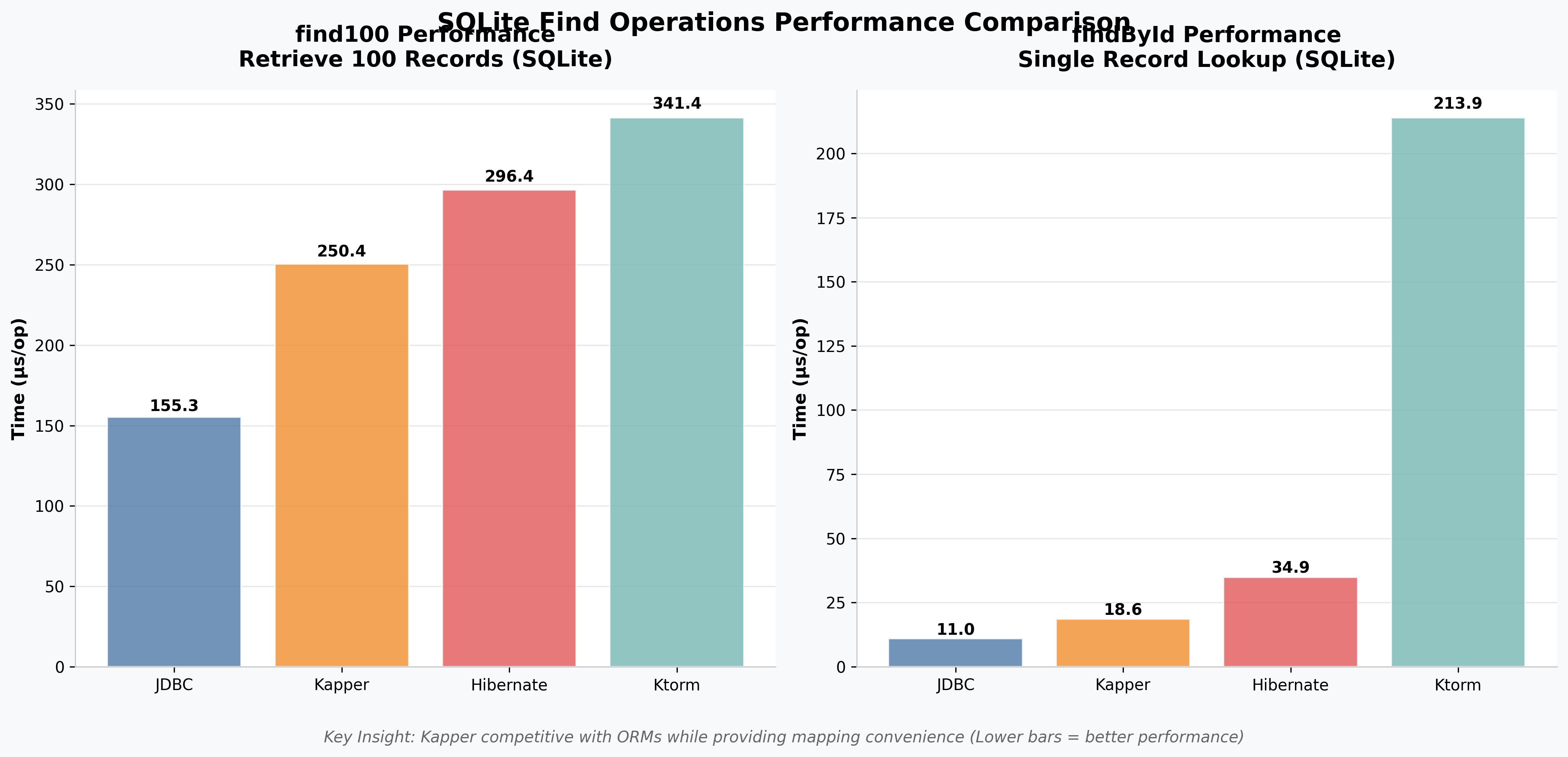
SQLite find operations comparison showing Kapper's competitive positioning
Key Findings:
- JDBC maintains raw performance leadership as expected for direct SQL
- Kapper with auto-mapping shows excellent ORM competitiveness especially vs Ktorm
- Ktorm significantly slower in single-record operations (10x slower findById)
Modification Operations Performance
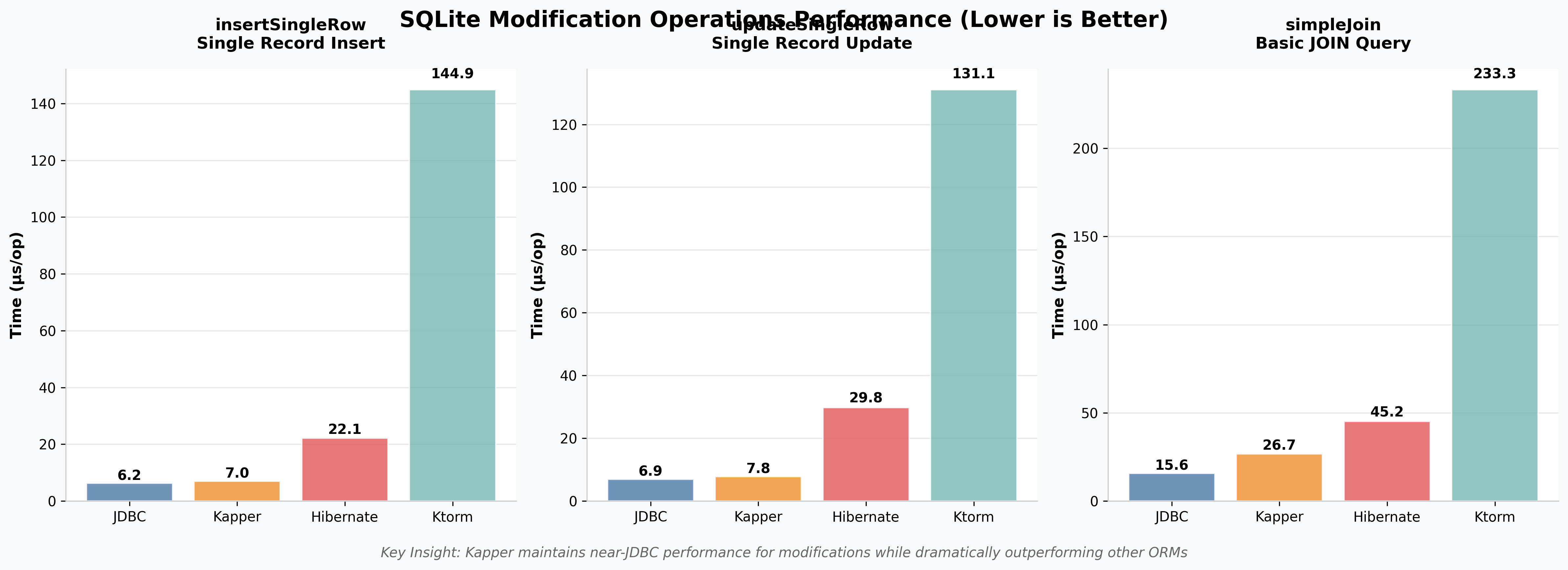
SQLite modification and JOIN operations showing Kapper's near-JDBC performance
Key Findings:
- Kapper nearly matches JDBC performance for modifications (10-13% overhead)
- Dramatic advantages over ORMs - 2-20x faster than Hibernate/Ktorm
- Consistent low-overhead pattern across all modification operations
Performance Categories Summary
Performance Trade-offs
JDBC vs Kapper:
- JDBC Advantages: Raw performance, no mapping overhead
- Kapper Advantages: Type safety, automatic mapping, cleaner code
- Trade-off: 10-70% performance cost for significant development productivity
Kapper vs Full ORMs (Hibernate):
- Kapper Advantages: 69-282% faster, predictable performance, no lazy loading
- ORM Advantages: Advanced features (caching, lazy loading, change tracking)
- Sweet Spot: High performance with essential mapping features
Kapper vs Kotlin DSLs (Ktorm):
- Kapper Advantages: 36-1970% faster, direct SQL control
- DSL Advantages: Type-safe query building, fluent API
- Trade-off: Kapper's SQL-first approach wins on performance
Kapper Mapping Strategy Comparison
Within Kapper itself, different mapping approaches offer performance trade-offs:
Mapping Strategy Performance (SQLite)
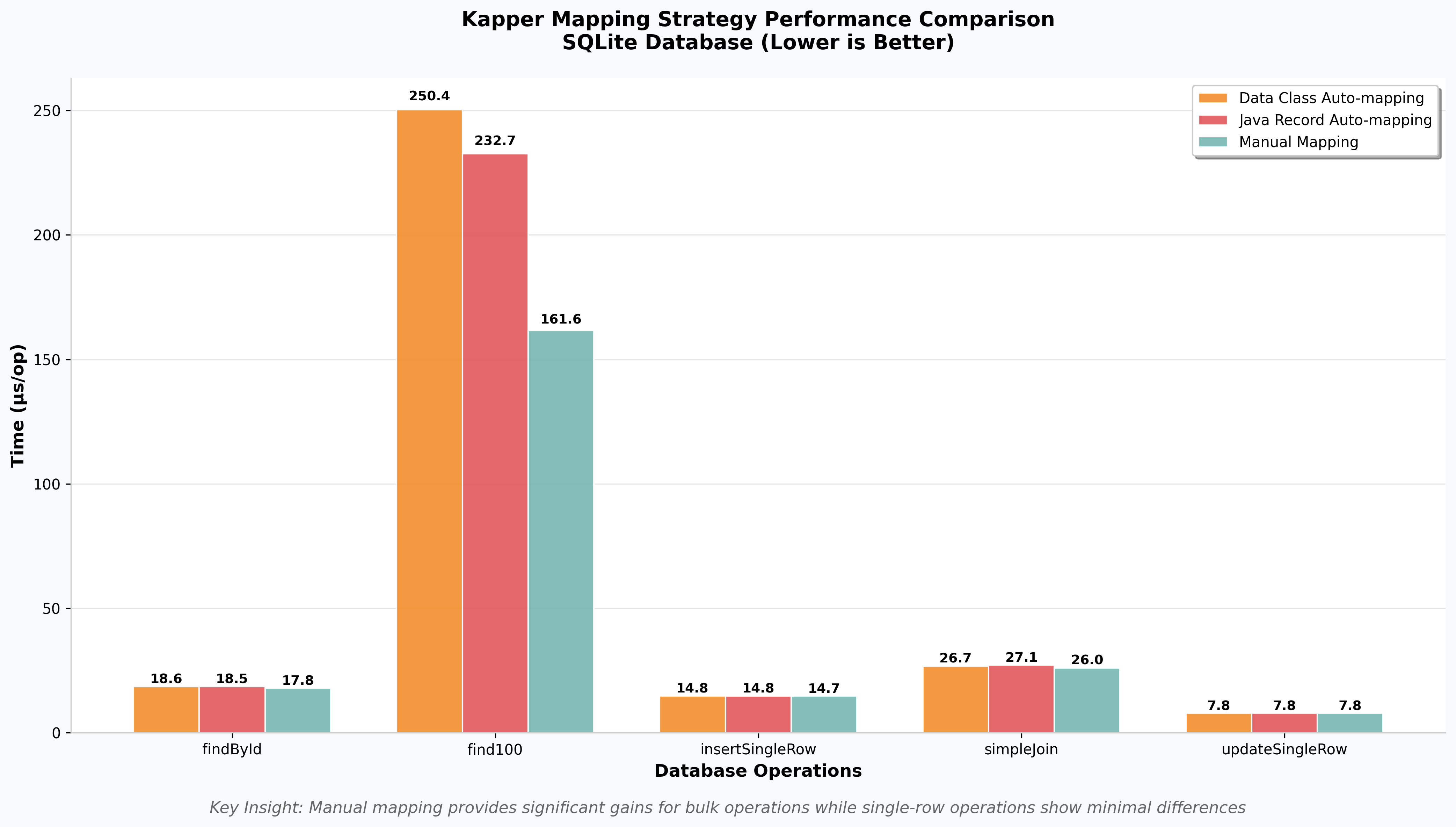
Detailed comparison of Kapper's different mapping strategies showing performance trade-offs
Performance Impact Analysis
Most Significant Gains:
- find100 (Bulk Operations): Manual mapping 35.5% faster than auto-mapping (161.6μs vs 250.4μs for Kotlin data classes)
Minimal Impact Operations:
- Single-row modifications: All strategies perform similarly (~0-2% difference)
- Simple lookups: Small but consistent manual mapping advantage (~4%)
Strategic Mapping Choices
kotlin
// High-frequency, performance-critical paths
connection.query("SELECT id, name FROM users") { rs, _ ->
    User(rs.getLong("id"), rs.getString("name"))
}

// Balanced performance with convenience
data class User(val id: Long, val name: String)
connection.query<User>("SELECT id, name FROM users")
Next Steps
- Performance History - Track performance evolution across versions